
BoSacks Speaks Out: A Tale of Two Publishing Houses
By Bob Sacks
Wed, Feb 4, 2026
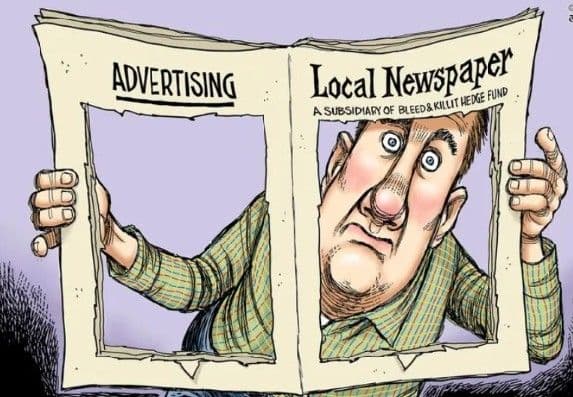
Today I’m sending out a tale of two publishing houses, a story so lopsided it feels like Dickens rewrote it for the media age, then handed the ending to an algorithm with a caffeine problem.
On one side stands The New York Times, expanding, innovating, reinventing itself with the calm confidence of an organization that still remembers what made it great, and has the discipline to keep building on it. On the other side sits The Washington Post, a once mighty institution now unraveling in public, shedding staff and stability like it’s trying to make itself lighter for an emergency landing.
And the rest of us? We are standing on the tarmac watching the smoke trail, shaking our heads, wondering how two legacy giants can be living such dramatically different fates on the same runway, in the same weather.
The Times: reinvention as a core muscle, not a panic move
The Times is doing what successful publishers have always done: investing while everyone else is rationing. They are building new journalistic and commercial muscles instead of arguing about which limb they can live without.
Here’s the key: the Times stopped thinking of itself as “a newspaper with a website.” It turned itself into a habit company. Not a “visit when something big happens” brand, but a “show up daily for multiple reasons” brand. News, yes, but also utility, pleasure, routine.
A few concrete examples:
- The bundle strategy: The Times has leaned hard into packaging experiences that keep people paying and staying, not just skimming headlines. Games and Cooking did not just add revenue, they added frequency. Wirecutter added commerce intent. The Athletic added sports passion at scale. This is how you build a subscription engine that is not hostage to the news cycle.
- Scale and momentum: Multiple reports point to the Times surpassing 12 million subscribers in 2025 and continuing to push toward a larger subscriber goal, using bundles to offset softness in news-only subscriptions.
- Ad performance through engagement: When you keep people inside your ecosystem longer, ads work better, and you can sell smarter, not louder. The Times has been tying engagement across products to stronger ad outcomes, including moves around video inventory inside its app.
This is not “tech magic.” This is publishing fundamentals, updated: diversify the offer, deepen the relationship, build repeatable habits.
The Times is using its history as a platform for reinvention, not as a museum plaque. That matters. I have seen too many legacy brands treat their past like a retirement plan. In media, nostalgia is a nice cologne. It is not revenue.
The Post: contraction that hollows out tomorrow
Now the other side of the tarmac.
The Washington Post is cutting about one-third of its staff, including substantial newsroom reductions, with major impacts across desks. Reporting indicates closures of the standalone sports and books departments, significant pullbacks in international coverage, and the suspension of the daily Post Reports podcast.
That is not a haircut. That’s a liver transplant performed with a butter knife.
The business explanation being cited is familiar: declining traffic, particularly from search, and the need to reshape the model for changing habits and technologies. Murray’s memo cited organic search falling by nearly half over three years.
The Post also appears to be dealing with compounded brand and subscriber damage tied to leadership decisions, including controversy around its 2024 presidential endorsement decision, which multiple reports connect to cancellations.
Former editor Marty Baron’s public critique adds another layer: when a newsroom gets hollowed out, it is not just a budget line, it is mission shrinkage, and he frames some of the harm as self-inflicted from the top.
You can debate tone. You cannot debate the pattern.
When you cut that deeply, you do not just reduce output. You scatter institutional knowledge, weaken beats, and make it harder to do the kind of journalism that differentiates you in the first place. Cutting sports and books is not just “less content.” It is less identity, less culture, fewer reasons for readers to keep you in their daily life when politics is not on fire.
Why this divergence feels personal, and yes, nostalgic
Maybe this hits so hard because many of us remember when both of these institutions were lodestars. They were part of the connective tissue of American media. They competed fiercely, sometimes obnoxiously, but they modeled what journalism looked like when purpose outweighed panic.
There was a time when you could walk into a newsroom and feel the machine humming. Copy desks, photo desks, editors arguing about one word in a headline like it was a Supreme Court ruling. The rhythm was brutal, but it was coherent. Everyone knew where the walls were.
Today the walls have moved. The floor is shaking. Search, which once fed publishers like a dependable river, is now a drought with occasional flash floods.
And here is where my production-and-logistics brain kicks in: a newsroom is not just talent, it is a system. When you remove a third of the system, you do not get “two-thirds of the value.” You get bottlenecks, missed edits, thinner reporting, and more reliance on rewrites and aggregation, which readers can smell from across the street.
It is like removing the bindery from a printing plant and telling the pressroom to “just be more efficient.” Sure. And while we’re at it, let’s remove the brakes from a car and ask it to drive more carefully.
What publishers should learn from this, without pretending we’re the Times
Most of us do not have NYT resources. Fine. Neither did many great publishers in the past, and they still built durable businesses. The lesson is not “be rich.” The lesson is “be intentional.”
Three practical takeaways:
Stop being single-reason-to-visit
If your brand is only useful when the world is on fire, you will be treated like a fire extinguisher: appreciated, then shoved back under the sink. The Times built multiple daily reasons to show up. You can do a smaller version of that with service journalism, local utility, niche expertise, events, newsletters, and membership.
Do not outsource your growth to platforms you do not control
The Post’s memo highlights what many of us already know: platform dependence is not a strategy, it is a liability.
Build direct audience pathways you own: email, app, membership community, recurring events, and products.
Cuts without a narrative create a downward spiral
Restructuring can be necessary. But if the public story is “we’re shrinking,” readers assume decline, staff assume instability, and competitors smell blood in the water. The Times story, by contrast, is “we’re building,” and people behave differently around builders.
BoSacks Final Thought
Legacy alone is not enough. Reputation alone is not enough. You do not “deserve” survival because you were once great.
The Times is charting its future with clarity, and investing in the habits that keep readers paying and staying. The Post is trying to stabilize by removing mass, but at this scale, it risks hollowing out the very differentiators that made it indispensable.
The rest of us should not just watch this like it’s a media soap opera. We should treat it like weather radar.
Because the lesson is painfully simple: you have to repair the ship while you’re still at sea, and you have to keep enough crew aboard to do the repairs.
Otherwise, you are not navigating the storm. You are just making the boat easier to sink.