
BoSacks Speaks Out: Production 101, Forty-Four Years Later
By Bob Sacks
Sun, Aug 30, 2026
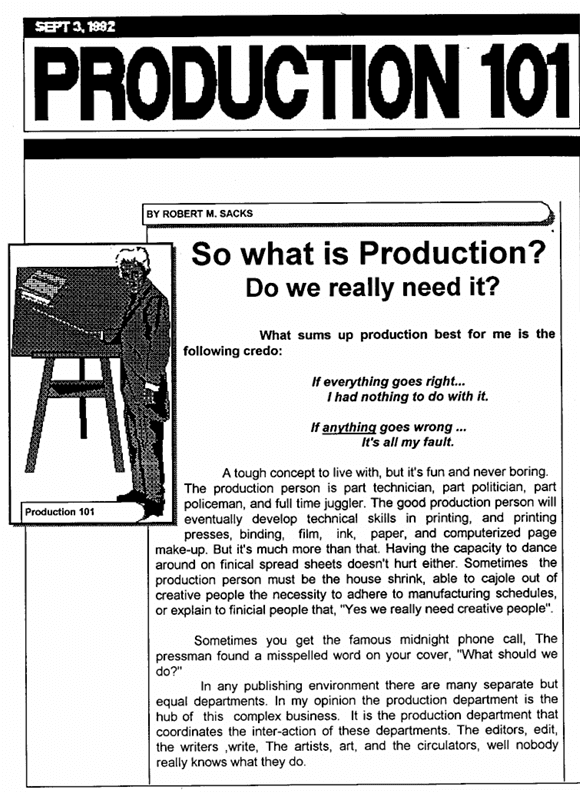
Carol and I are moving next week to a smaller house, still here in Charlottesville. That means confronting and emptying an extremely large attic containing nearly 30 years of accumulated life, work, memories, boxes, papers, and assorted things we once believed we absolutely had to save.
Moving is not merely changing addresses. It is an archaeological expedition through your own life.
As we unburden ourselves and declutter, I am uncovering some vintage Bo production “stuff.” Among the discoveries were six pages from a course titled Production 101, dated September 3, 1982, and credited to Robert M. Sacks. I believe I presented it in-house at McCall’s magazine.
The first page asks two wonderfully basic questions:
“So what is production? Do we really need it?”
I then offered my production credo:
“If everything goes right, I had nothing to do with it. If anything goes wrong, it’s all my fault.”
Forty-four years later, that still sounds about right.
The technology described in the course now belongs in a publishing museum. The production cycle included page dummies, paste-up, negatives and positives, film, blueprints, printing plates, press approvals, binding, mailing, and newsstand delivery. “Computerized page make-up” was still new enough to deserve special mention.
Today we have cloud-based workflows, content-management systems, digital asset libraries, automated preflighting, PDFs, websites, apps, newsletters, podcasts, video, social media, audience databases, analytics, and now artificial intelligence. We can publish globally in seconds, revise a story after publication, and produce multiple versions for different platforms and audiences.
The tools have changed beyond anything I could have imagined in 1982. The fundamental responsibilities have not.
I described the production person as “part technician, part politician, part policeman, and full-time juggler.” I also said that the production department was the hub coordinating the separate departments of a publishing company.
That function remains essential, even when nobody calls it production anymore.
Today it may be divided among editorial operations, product development, design, engineering, audience development, advertising operations, data management, and distribution. The old production department has been scattered across the organization, but the need for someone to understand the complete process has only increased.
Somebody still has to know where the content is, what condition it is in, where it is going, who must approve it, what it will cost, and whether it will arrive when promised. Every step is still a handoff, and every handoff remains an opportunity for error.
A late digital file is still late. Incorrect metadata can be as damaging as bad film. A broken link can be the modern equivalent of a missing printing plate. An automated workflow can distribute a mistake faster than any printing press ever could.
Artificial intelligence adds remarkable new capabilities, but it does not eliminate production judgment. In fact, the faster our systems become, the more important experienced judgment becomes. AI can create, edit, resize, translate, summarize, and distribute content with astonishing speed. It can also manufacture an error and spread it across every platform before lunch.
Speed is useful. Speed without control is simply a faster route to trouble.
One page of the old presentation stated my first rule in enormous type:
DON’T PANIC.
Underneath it, I wrote:
“Somebody knows the answer, and the magazine will always come out.”
That may be the most durable production lesson of them all. Problems are inevitable. Presses fail. Files become corrupted. Systems go down. People miss deadlines. Technologies change, vendors disappear, and someone will always discover an error at the worst possible moment.
Panic fixes none of it.
The job is to understand the process well enough to find the answer, make a decision, protect the product, and keep moving.
The final pages of the course dealt with color and carried another large headline:
“IT’S ALL AN ILLUSION.”
That was true when we were separating images into printing inks, and it remains true when readers view our work on thousands of differently calibrated screens. Publishers have more technological control than ever, yet we still cannot guarantee that every reader will see precisely what we intended.
Looking back, I am struck by how little my underlying philosophy has changed. Production was never merely about manufacturing pages. It was about transforming an idea into something that could reliably reach an audience without losing its meaning, quality, schedule, or economic sanity along the way.
That remains the job.
The machinery has become smarter. The workflow has become faster. The number of distribution channels has multiplied almost beyond counting.
But somebody still has to understand how the whole damn thing works.
And when something goes wrong, production still gets the phone call.