
BoSacks Speaks Out: Same Problem, Different Playbook
By Bob Sacks
Sat, Mar 7, 2026
The recent article by Sajeeda Merali of the UK’s PPA does not describe a new problem or a uniquely British dilemma. It describes the same structural extraction that has been hollowing out publishing everywhere, just with a different accent and a different regulatory vocabulary.
Change the acronyms. Swap London for Washington.
The outcome is identical.
Publishers are losing traffic.
Platforms are keeping the value.
AI is the accelerant.
The disease is the same.
Only the excuses change.
This Is Not a Traffic Dip. It Is a Transfer of Power.
On both sides of the Atlantic, publishers are watching something far more serious than a decline in clicks. They are watching distribution authority move permanently out of their hands.
AI summaries are not a feature. They are a takeover.
When AI Overviews appear in US search results, publishers see clickthrough rates collapse by 50 to 90 percent. That is not an optimization failure. That is economic displacement. That is what happens when the platform decides it no longer needs to send users to the people who did the work.
The UK data cited by the PPA tracks the same collapse almost perfectly. Different regulators. Same result.
Then there is the quiet statistic that should terrify anyone still clinging to search as a reliable channel. Zero-click searches jumped from roughly 56 percent to 69 percent in a single year. At the same time, organic traffic to US websites dropped by hundreds of millions of visits.
That traffic did not disappear.
It was captured.
Captured by systems that summarize content without paying for it, answer questions without attribution that matters, and monetize attention without sharing the proceeds.
Publishers are no longer partners in distribution.
They are unpaid suppliers.
The UK Coordinates. The US Litigates. Neither Is Winning.
The difference between the UK and the US is not strategy. It is temperament.
The UK is trying to manage the damage through coordination, campaigns, and regulatory process. The Make It Fair effort and the CMA inquiry at least acknowledge that something foundational has broken.
The United States, by contrast, has done what it always does. It has turned the problem over to lawyers and hopes the courts will sort it out.
More than seventy copyright lawsuits later, the results are incoherent.
One case ends in a $1.5 billion settlement. Another declares mass ingestion of copyrighted books “highly transformative.” The message is not clarity. The message is chaos.
And while publishers argue in court, platforms keep shipping product.
Meanwhile, ideological infighting muddies the water even further. Some advocates warn that licensing requirements could entrench Big Tech.
Big Tech is already entrenched.
The question is whether publishers will be compensated for feeding it.
US Publishers Are Fractured and the Platforms Know It
If platforms have leverage, it is not just because of technology. It is because publishers are negotiating against themselves.
In the United Kingdom, publishers are at least attempting to behave like an industry. They may not agree on every tactic, but they are trying to present a collective position. Campaigns such as “Make It Fair” exist for a reason. The Professional Publishers Association has stepped forward publicly. Regulators, lawmakers, and technology companies know who is sitting across the table.
There is a voice.
In the United States, the situation looks very different. Publishing here has fractured into a patchwork of individual strategies, private licensing deals, lawsuits, quiet negotiations, and a great deal of nervous silence.
Everyone is maneuvering. No one is leading.
Some publishers are signing agreements with AI companies. Others refuse to participate. A few are suing. Some are negotiating quietly while publicly criticizing the very companies they are negotiating with. Trade groups issue statements, but none carry the authority of an industry-wide mandate.
Which raises a simple question.
Who speaks for American publishing?
The honest answer is uncomfortable. No one who actually represents the full industry speaks for it.
You hear individual executives. You hear lawyers. You hear trade associations with partial constituencies. You hear venture capitalists who suddenly claim expertise in journalism. You even hear technologists explaining what publishing should become.
But the industry itself, as a coherent voice, is largely absent.
What fills the vacuum instead are commentators, analysts, and long-time industry observers. People like me. A handful of others who have spent decades inside the machinery of publishing. We write essays, deliver speeches, host forums, and try to describe what is happening.
Let me be clear about something.
We are not representatives. No one elected us. No board authorized us. No industry body empowered us to negotiate on behalf of anyone.
We are experienced critics. That is all.
We are the people standing on the sidelines pointing out that the house is on fire while the owners argue about who should call the fire department.
That is not how a mature industry behaves during a structural disruption.
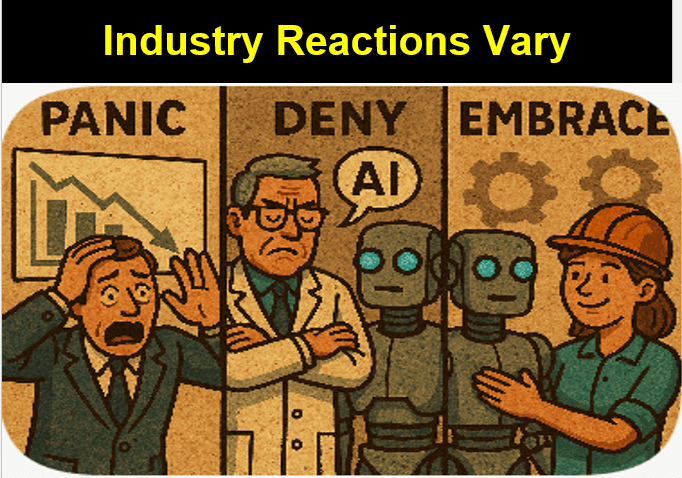
Some publishers are cutting licensing deals in private. Others are refusing on principle. Some are experimenting with revenue sharing. Others are holding the line and watching their traffic collapse.
Forbes walks away from a Perplexity deal, saying it undervalues its journalism. TIME, Fortune, and the Los Angeles Times sign on to alternative programs that generate modest checks and good press releases.
None of this replaces search revenue.
None of it restores bargaining power.
These deals are not solutions. They are coping mechanisms.
Platforms understand this perfectly. Fragmentation is not a side effect. It is leverage.
The Adaptation Narrative Is Wearing Thin
Publishers are told, once again, to adapt.
Build subscriptions. Invest in video. Strengthen direct relationships. Experiment with AI tools. Launch newsletters. Build communities. Start podcasts.
We have heard this sermon before. It is repeated at every conference and written into every strategic memo.
To be fair, publishers are experimenting.
The Washington Post is rolling out AI generated audio.
Yahoo is personalizing news summaries.
TIME has introduced an AI interface that lets readers interact with its archive.
These are smart moves. They show creativity and urgency.
They are also defensive moves.
None of them addresses the core structural issue: discovery has been commandeered by platforms that no longer need to send traffic in order to profit from the content ecosystem.
Search engines once functioned as distributors. They sent readers outward. Now they increasingly behave like destinations. The answer appears directly in the interface. The visit never occurs.
You cannot innovate your way out of a distribution chokehold.
This debate is often framed as a legal or philosophical dispute. Copyright. Fair use. AI ethics.
Those questions matter, but they are not the center of gravity.
The real issue is far simpler.
Who controls access to audiences, and who gets paid when information moves.
The United Kingdom is trying to negotiate new rules. The United States is fighting old battles in court. While both sides debate frameworks, the platforms continue reshaping the economics of publishing in real time.
Publishers are no longer debating growth strategies.
They are negotiating the terms of their continued relevance.
What the Industry Should Actually Be Doing
If adaptation alone is not enough, then the industry needs to start thinking like an industry again. A few steps would change the conversation immediately.
1. Build Collective Licensing Structures
Publishers must stop negotiating individually where possible. Collective licensing bodies, similar to music rights organizations, would create standardized frameworks for AI training and content use.
When rights are aggregated, bargaining power increases. Fragmented negotiations benefit the platforms, not the publishers.
2. Demand Transparency from AI Systems
Publishers should push for verifiable reporting on how their content is used in AI training and output generation. Usage logs, attribution signals, and compensation mechanisms should be built into the infrastructure.
If AI companies can measure tokens and compute cycles down to microscopic detail, they can measure content usage as well.
3. Rebuild Direct Distribution Channels
Traffic dependence on platforms is the structural vulnerability. Publishers need to accelerate investment in channels they control: newsletters, memberships, events, apps, and curated communities.
The goal is simple. Own the relationship, not just the content.
4. Treat Archives as Strategic Assets
Publishers sit on decades of structured knowledge. Archives are not just historical records; they are training data, research libraries, and premium content products.
Organizing, licensing, and monetizing these archives should be a central strategic priority.
5. Coordinate Public Policy Messaging
Whether through trade organizations or new coalitions, publishers must present consistent positions to regulators. Policymakers cannot defend an industry that cannot articulate what it wants.
A fragmented message produces fragmented outcomes.
The Clock Is Already Running
The past twenty years offer a useful lesson.
When platforms decide they are done being distributors and start becoming destinations, the timeline accelerates dramatically. The transition feels gradual until suddenly it is not.
By the time an industry recognizes that distribution has shifted, the economic center of gravity has already moved.
Publishing now stands in that exact moment again.
The question is no longer whether adaptation is necessary. Of course it is.
The real question is whether publishers will adapt individually or whether they will finally act collectively while there is still leverage left.
Because once the distribution system fully closes, adaptation stops being strategy.
It becomes survival.
Are any of these solutions possible or achievable? Perhaps.
But history suggests a familiar obstacle. American publishers have never been especially gifted at collective action. We compete brilliantly; we coordinate poorly.
Until that changes, the industry will keep trying to solve systemic problems with individual strategies, and individual strategies are not capable of fixing structural failures.