
BoSacks Speaks Out: The Byline Was Never Supposed to Belong to a Machine
By Bob Sacks
Sat, May 16, 2026
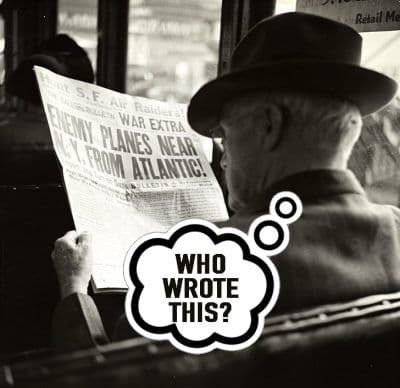
I read with great interest the recent New York Times article titled “Reporters at McClatchy Withhold Bylines in Dispute Over A.I. Content.” It describes journalists refusing to allow their names to appear on AI generated versions of their reporting. Their frustration is not only understandable. It is entirely justified. In fact, it is a long overdue act of professional self‑respect.
A byline is not decorative typography floating above a story. It is identity. It is reputation earned one deadline at a time. It is accountability, pride, ego, experience, and the long slow accumulation of trust between a journalist and an audience. A byline is the writer standing in front of the reader and saying with clarity that these are my words, this is my reporting, and I stand behind every sentence.
I still remember my first byline in my first publication, The Express. I know it was a silly thought, but I felt I had achieved an almost immortality. That it would last forever. It felt good. It felt like arrival. It felt like purpose. Anyone who has ever earned a byline knows that feeling. It is not something you hand over lightly. And it is certainly not something you attach to a machine generated remix of your own work.
Yet now management wants reporters to permit AI systems to summarize, reshape, remix, and repurpose their reporting into multiple versions for different audiences while still attaching the journalist’s name to the final product. That is the line many reporters refuse to cross. And I do not blame them for a single second.
We have already seen what happens when publishers attempt to automate journalism without understanding the consequences. AI generated sports stories have invented plays that never occurred and confused winning teams with losing teams. Financial summaries have misstated earnings and misinterpreted filings. Local news experiments have produced stories so generic they could have been written about any town in America. In almost every case the machine made the mistake while the human being carried the reputational damage. That is not augmentation. That is corporate risk transfer dressed up as innovation.
The irony in the McClatchy situation is almost perfect. According to the New York Times, executives reportedly argued that attaching established reporters’ names to AI generated content would improve Google authority and search rankings. Think about that for a moment. The company still desperately needs the credibility of human journalists while simultaneously trying to automate portions of the journalism itself. The machine gets the efficiency. Management gets the scale. Google gets more inventory. The journalist gets the liability.
I have been warning for years that this exact moment was coming. AI is not simply another production upgrade. It is not the shift from hot type to cold type. It is not desktop publishing. It is not QuarkXPress replacing paste-up boards or pagination software replacing waxers and X-Acto knives. Those technologies changed workflow. This technology reaches directly into the intellectual and ethical core of the publishing business itself.
We are no longer automating printing plates, trucking routes, or ad trafficking. We are automating interpretation, summarization, voice, nuance, and eventually editorial judgment. That is a very different animal.
To be fair, I understand the pressures management faces. Newspaper economics are brutal. Digital advertising is unstable. Print circulation continues to shrink. Search traffic is collapsing as AI generated answers increasingly keep readers away from publisher websites altogether. More content theoretically means more search visibility, more ad inventory, and more subscription hooks. Hedge funds love scalability because spreadsheets do not care about newsroom morale. Wall Street loves efficiency because quarterly earnings reports do not measure civic trust.
Readers, however, still care deeply about trust. And trust is fragile.
We have seen this movie before. The pivot to video destroyed jobs and newsroom stability because executives chased Facebook traffic that vanished almost overnight. Clickbait headlines cheapened respected brands and trained audiences to expect sensationalism over substance. Programmatic advertising flooded websites with garbage ads that degraded the reader experience. Social media algorithms rewarded outrage instead of accuracy. Every time publishers treated journalism as an infinitely scalable commodity, audiences responded by valuing it less.
Now we are entering the next chapter of that same mistake.
The moment readers begin wondering whether they are consuming journalism or merely a machine generated approximation of journalism, the entire enterprise enters dangerous territory. Audiences may tolerate AI assistance. They may even appreciate quick summaries or customized versions of stories. But readers still want to believe that an actual human being gathered the facts, understood the context, recognized the nuance, and exercised editorial judgment.
Machines can process language. They cannot attend a city council meeting and recognize tension in the room. They cannot build confidential sources over twenty years. They cannot understand when a politician is dodging a question with carefully crafted language. They cannot smell fear, corruption, arrogance, or desperation. Good journalists can. At least for now.
The danger is not the existence of AI itself. The danger is the temptation by publishers to transform journalism into endlessly recyclable content slurry optimized primarily for algorithms instead of audiences. That path leads directly toward commoditization. And commodities rarely command loyalty, premium pricing, or cultural importance.
Publishing has always sold judgment, credibility, authority, and human insight. The byline is the connective tissue between the journalist and the journalism. It is proof of authorship and an anchor of accountability. Undermine that connection and you are not modernizing the business. You are cannibalizing the very asset you claim to protect.
The byline still matters. Perhaps now more than ever. In a world increasingly flooded with synthetic content, readers may soon discover that authentic human judgment is not a relic of the past. It may become the publishing industry’s last truly premium product.