
BoSacks Speaks Out: The Future Has Been “Just Beginning” for a Very Long Time
By Bob Sacks
Thu, May 28, 2026
The other day I was digging through old lecture notes looking for one forgotten slide, one forgotten quote. I never found it. What I found instead was far more interesting: proof that some of us in publishing have been arguing about the same future for more than twenty years.
The technology changed. The platforms changed. The jargon changed. But the core reality has not.
Back in 2005, I told an MPA audience:
"New methods of delivery, technologies and delivery substrates will continue to emerge. But none of that will mean a hill of beans if you don't have the very best personal relationship with your readers, a relationship that's only achieved with the best-written words possible."
Twenty-one years later, I would not change a word of that.
Here is the funny thing about this business. We keep pretending every technological wave is the final destination when in reality it is just another connecting flight. We survived hot type, cold type, offset printing, desktop publishing, the web, mobile, social media, programmatic advertising, and search engines. Now we are navigating artificial intelligence. And yet every few years somebody declares the old rules dead and the new gods immortal. Then the market shifts again and everybody suddenly becomes a futurist with amnesia.
I also found another Bo-line from those early talks in 2007 that still feels painfully accurate today:
"The new world of information distribution is still in its infancy. It is only the top of the first inning in a doubleheader and there is only one out."
At the time, people thought that sounded dramatic. Today it sounds conservative.
We are still in the infancy stage. Artificial intelligence has not stabilized publishing. It has detonated the pace of change. Search traffic is collapsing. Referral economics are evaporating. Machines increasingly summarize journalism without rewarding the people who paid to create it. And yet at this exact same moment, smart publishers have more opportunity than ever to build direct authority, niche expertise, membership models, premium information products, and trusted communities. The crisis and the opportunity are arriving together. They always do.
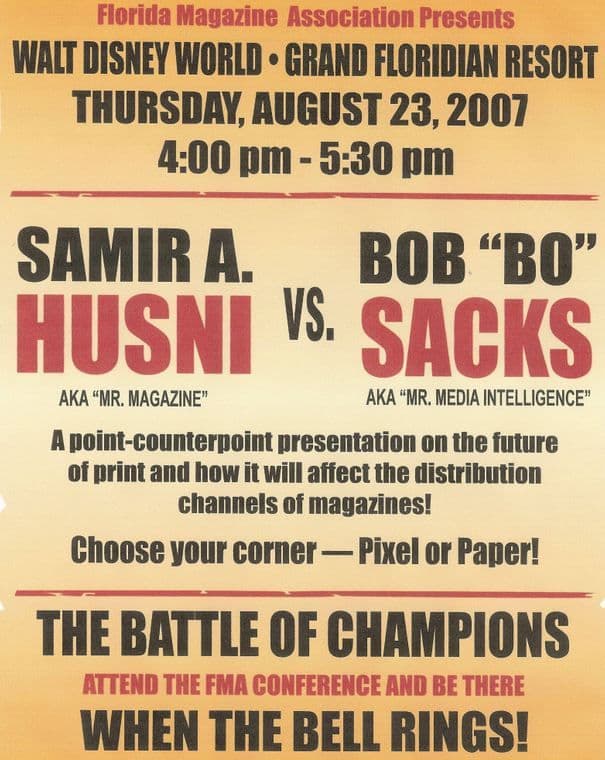
Even more revealing was something I said during my second public debate with Professor Samir Husni in August of 2007. At the time, many publishers still believed digital disruption was temporary turbulence rather than permanent structural change. I disagreed then. I disagree now.
I said:
"We are currently trying to prepare students for jobs that don't yet exist. Using technologies that haven't been invented. In order to solve problems we don't even know are problems yet."
Nearly twenty years later, that no longer sounds like prediction. It sounds like Tuesday.
The uncomfortable truth is that publishing has been living in permanent transition for decades. The tools keep changing. Distribution channels mutate constantly. Entire revenue models appear, disappear, and then reappear disguised as innovation. We keep acting surprised. We should not be.
Back in 2013 at the MPA IMAG conference, I quoted my friend Drew Davis of Tippingpoint Labs, who said:
"We are in a period of information overload. Just because more information is available doesn't mean we have the time or skill to consume more information."
That observation has aged remarkably well. In fact it may be more important now than the day he said it. The problem today is not a lack of content. The world is drowning in it. AI is flooding the market with more words, more videos, more summaries, more newsletters, more podcasts, and more automated noise than humanity can possibly absorb.
Which means the future advantage is not volume. It is judgment.
In that same 2013 lecture I wrote:
"There is a consumer shift happening that is as yet under reported and perhaps not yet understood. It is the diminishment of physically owning some types of consumer products and replacing them with cerebral/corporate ownership."
At the time I was thinking about the early migration from physical products toward digital access, streaming media, cloud services, and subscription ecosystems. Consumers were beginning to care less about owning shelves full of things and more about access to experiences, ideas, information, and communities.
Now look around.
Spotify replaced record collections. Netflix replaced DVD towers. Kindle libraries became invisible. Software moved into the cloud. Even automobiles are increasingly becoming subscription platforms on wheels. Younger consumers value access over possession and identity over accumulation.
Publishing sits directly in the center of that shift.
What we really sell is not paper, ink, pixels, or apps. We sell perspective, authority, escape, insight, and a sense that somebody intelligent is helping readers make sense of a chaotic world. We sell cerebral/rented ownership. Readers may not physically own the product the way they once did, but they absolutely want ownership of the ideas, knowledge, and emotional connection that product provides.
The publishers who understand this are building memberships, events, newsletters, podcasts, research products, premium communities, and highly specialized information services. The publishers who still think they are merely shipping pages from point A to point B are slowly becoming museum exhibits.
In that same 2013 lecture I also wrote:
"The longevity of any business plan is now subject to radical change from unseen events and unpredictable catalysts. These consist of social and technological advances that cannot be forecast to any great extent."
Looking back, that feels less like prediction and more like a weather report. Few publishers foresaw smartphones reshaping reading habits overnight. Few anticipated social media platforms becoming global distribution monopolies. Almost nobody predicted that artificial intelligence would one day summarize journalism without ever sending readers to the original source.
Stability itself has become temporary. The old publishing model was built around long planning cycles, predictable consumer behavior, and gradual technological evolution. Today an unforeseen platform change, algorithm adjustment, cultural shift, or AI breakthrough can alter audience behavior in months instead of years.
Which is exactly why flexibility has become a survival skill rather than a management philosophy.
Publishing is not fundamentally a paper business, a platform business, or even a technology business. It is a trust business. It is a relationship business. The delivery mechanism changes every decade. Human curiosity does not.
The irony of the AI era is that machines may make human trust more valuable, not less. When the world fills with synthetic noise, audiences will pay a premium for authenticity, judgment, expertise, and recognizable editorial voices.
In 2013, I quoted Joe Sexton of The New York Times, who said something that deserves to be carved into the wall of every newsroom and publishing office in the world:
"If you are not asking yourself every couple of years how to once more scare yourself to death, then you are living something of the coward's life."
He followed that with:
"Ain't no room for cowards in journalism at this moment in time."
He was right then. He is even more right now.
Publishing has always rewarded the restless. The experimenters. The entrepreneurs. The slightly crazy people willing to launch a magazine during a recession, start a newspaper with no money, build a newsletter before newsletters were fashionable, or bet on technologies before they were proven. Lord knows I have made a career out of questionable decisions disguised as vision.
But here is the important part. None of the experimentation matters if the product itself loses its soul.
You can have AI workflows, automation, predictive analytics, personalization engines, and delivery systems flying at the speed of light. But if the words are weak, the reporting is shallow, and the relationship with the audience is transactional instead of meaningful, then all you have built is a very efficient machine for distributing mediocrity.
The tools will continue to evolve. They always do. The mission does not.
The publishers who survive this era will not necessarily be the biggest. They will be the most trusted, the most distinctive, and the most fearless about reinventing themselves before the market forces them to.
The future has been "just beginning" for a very long time. Every generation of publishers thinks they are living through unprecedented disruption. Maybe they are. Publishing has always been a business built by restless people willing to leap into uncertainty armed mostly with instinct, caffeine, and unreasonable optimism.
But here is what decades in this business have taught me.
The machinery always changes faster than human nature.
The platforms change. The tools change. The economics change. Human curiosity does not. People still want insight. They still want trustworthy voices. They still want stories, ideas, intelligence, humor, escape, and meaning.
That is why publishing survives every technological revolution thrown at it. Not because the industry is stable. Frankly, publishing has always been slightly insane. It survives because the human need to communicate, learn, and make sense of the world never disappears.
The future has been "just beginning" for a very long time now.
And that is probably exactly the way it is supposed to be.