
BoSacks Speaks Out: Welcome to Advertising’s No-Human Future
By Bob Sacks
Fri, Jan 16, 2026
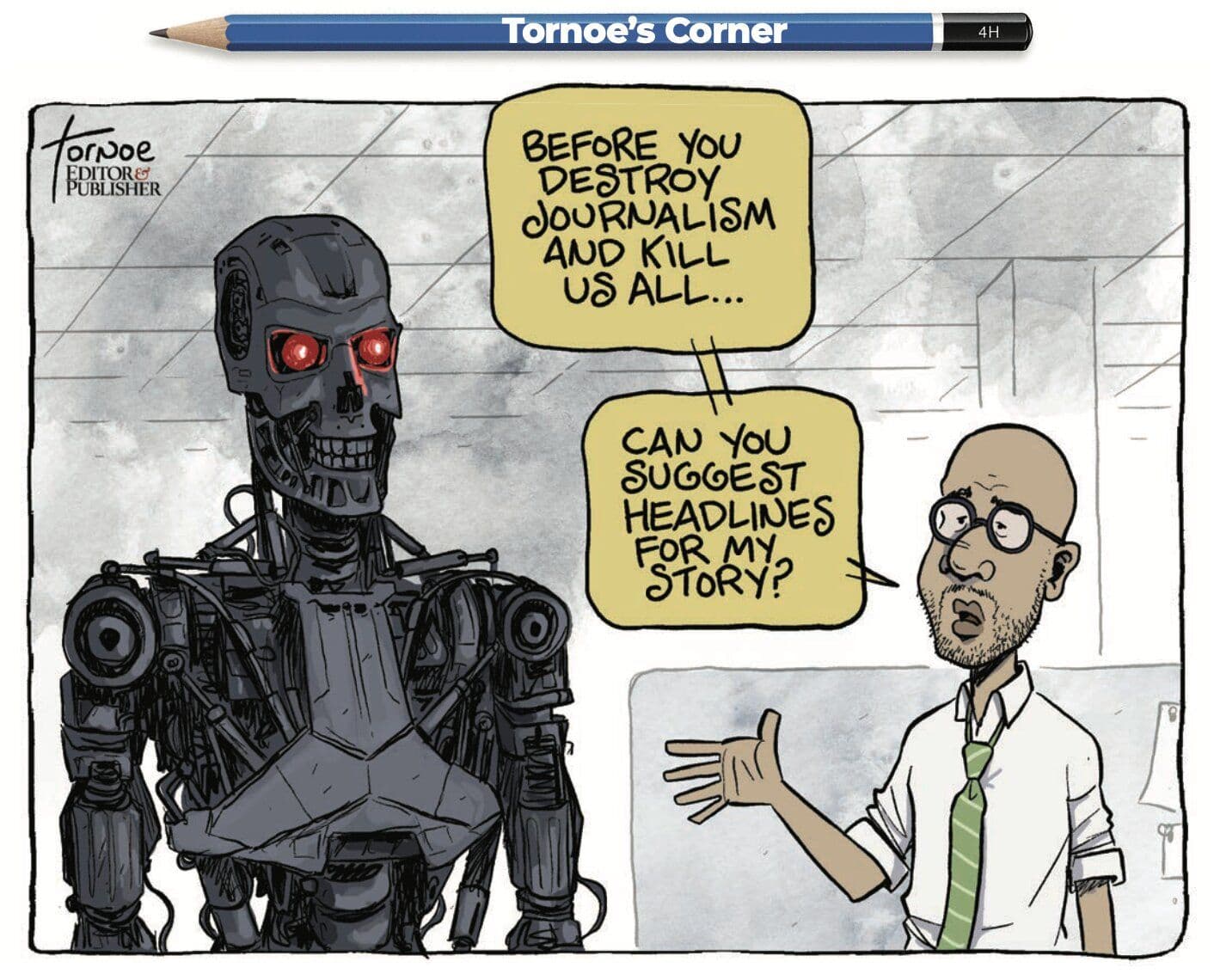
There is an article published today by the International News Media Association (INMA) that dives deep into the tangled weeds of today’s advertising theories, hopes, and hype. I’ll admit, some of the processes discussed are beyond my pay grade, and I won’t pretend to grasp every nuance. But here’s the thing: it’s complex, it’s consequential, and it’s absolutely worth your time. Even if you just skim for the gist, you’ll get a clear sense of where our industry is headed, and why it matters.
Advertising is getting weirder and creepier every day. What’s being sold today in advertising isn’t innovation, it’s automation theater. AI agents buying media. AI agents selling media. AI agents optimizing, reporting, negotiating, reallocating, and high-fiving each other in server racks at machine speed. The mission is clear and proudly broadcast: no human in the loop.
Translation? No humans. No jobs. No payroll headaches. No coffee breaks. No dissent.
From an efficiency standpoint, sure, Bo gets it. Automation is cheaper, faster, tireless, and increasingly better than humans at pattern recognition, pricing, and optimization. This isn’t just the future of advertising, it’s the future of any industry that can be reduced to data, rules, and repeatable decisions. Advertising is simply the canary in the CPM coal mine.
When the industry cheers “no human in the loop,” as in the article below, what it’s really applauding is a world where judgment, creativity, negotiation, and institutional knowledge are labeled as friction. And friction, in Silicon Valley math, must be eliminated.
Here’s the question nobody on stage wants to touch:
I’ve written about this a few times before.
What happens to the displaced talent?
We’re talking about an army of smart, experienced professionals, media planners, buyers, sellers, analysts, account managers, freelancers, and strategists. People who understand brands, audiences, nuance, and risk. People who built this industry long before AI decided it could run the table.
The glib answer? Retraining. The fantasy? They’ll all become AI whisperers, prompt engineers, or “strategic overseers.” Magical thinking. There aren’t enough of those jobs, and even those roles are being automated faster than LinkedIn can update the job descriptions.
The cynical answer?
“They’ll find something else.”
Like what? Flipping burgers? Sorry, robotic grills and AI kitchens have that covered. Warehouse work? Automated. Customer service? Bots. Driving? Give it a minute. Writing? Editing? Designing? Ask anyone who just lost a freelance gig to a machine that works for pennies per thousand words.
Efficiency isn’t Sustainability. A system that maximizes output while discarding human capital without a plan isn’t innovation, it’s extraction.
Advertising used to be a human business with machines as tools. Now it’s becoming a machine business with humans as optional accessories. That shift has consequences far beyond quarterly margins.
If publishers, agencies, and platforms don’t start asking harder questions about labor, value, and accountability, we’re on track to build an industry that runs flawlessly and serves no one. Not workers. Not brands. Not audiences.
Yes, I believe that AI will keep accelerating; that’s inevitable. But let’s stop pretending that “no-human-in-the-loop” is progress. It’s not. It’s a stress test for society. Strip humans out of the system, and you strip out the economy that sustains it. If nobody has a paycheck, who’s buying the products you’re advertising? No buyers. No brands. No ads. That’s not innovation, it’s a death spiral.
Here’s some reality to chew on: Media and entertainment layoffs, including advertising roles, hit 17,000 jobs in 2025, up 18% from 2024, driven by restructuring and AI adoption.
Forrester predicts a 15% reduction in agency jobs in 2026, calling it a “seismic shift” as agencies morph into tech-driven marketing solution providers. And in December 2025 alone, the U.S. advertising sector shed 2,800 jobs, a clear sign of structural cracks.
At least 3,434 journalism job cuts were tracked in the U.S. and UK during 2025, according to Press Gazette. About 70% of these cuts were in the U.S., and most affected editorial roles, though some included product and commercial teams. Just for fun, I’ll add this to the picture. The International Labor Organization reported that global employment dropped by about 7 million jobs in 2025 due to rising uncertainty. That is a lot of lost purchasing power.
Bo's Final Thought:
The future shouldn't be just about machines. It must be about people, about preserving the spark of judgment, imagination, and purpose that no algorithm can replicate. Automation should amplify human creativity, not erase it. Strip humans out of the system, and you strip out the economy, the culture, and the soul of the industry. If nobody has a paycheck, who’s buying the products you’re advertising? No buyers. No brands. No ads. That’s not progress, it’s a death spiral.
Industry leaders need to act now. Ask the hard questions about labor, value, and responsibility before the table is replaced by a server rack and a press release celebrating record efficiency. The real challenge isn’t speed, it’s balance. Build a future where machines handle the repetitive and humans handle the meaningful. Because if we lose our seat at the table, what’s left isn’t innovation, it’s surrender to the terminators.