
BoSacks Speaks Out: When Frequency Becomes Harassment
By Bob Sacks
Tue, Oct 20, 2026
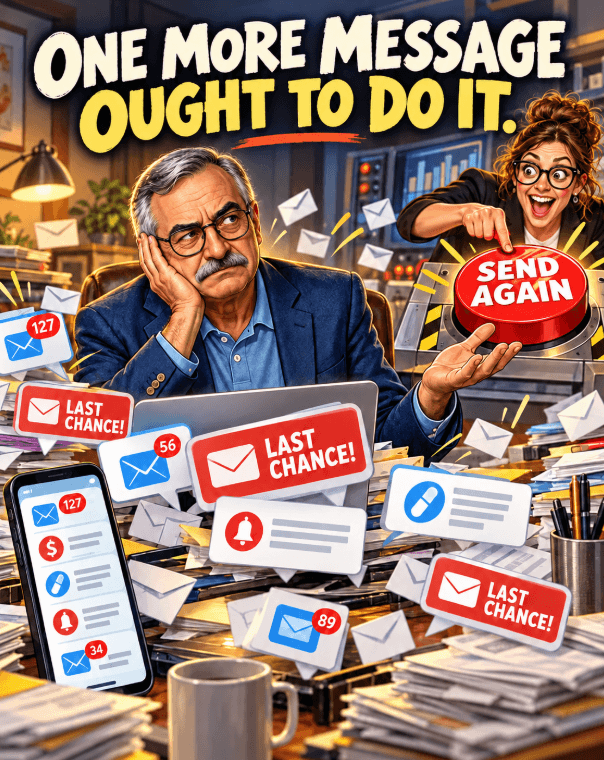
BoSacks Speaks Out: When Frequency Becomes Harassment
To nobody’s surprise, I am an opinionated man.
No doubt about it.
I have comments about damn near everything, including many things that never asked for one.
Sometimes I keep those opinions to myself. Sometimes I provide what might generously be called running commentary.
Watching television with me in the room is an endurance exercise that only Carol has learned to tolerate. After more than 50 years in media, marketing, and publishing, I cannot simply sit quietly while a terrible commercial insults both the people in it and the people watching it.
“That’s just stupid” is probably my most frequent review, although it is sometimes followed by, “Who approved this?” “What are they trying to sell?” or “Has anyone involved in this commercial ever met an actual human being?”
Carol has heard my unsolicited critiques for years. At this point, she deserves either a medal or noise-canceling headphones.
Apparently, the advertising theory is that if consumers see people incapable of washing a shirt, choosing insurance, ordering dinner, or completing an ordinary household chore without creating a catastrophe, they will rush out and buy whatever product promises to rescue them.
Why portraying customers as morons sells anything remains one of life’s enduring mysteries.
I assume it must work often enough to survive because advertisers have been doing it for decades. Then again, publishing history is filled with practices that continued long after they stopped making sense. “We’ve always done it this way” may be the most expensive sentence in the English language.
But stupid television commercials are not what set me off today.
Apria, my medical supplier, deserves the credit, or perhaps the blame, for inspiring this particular vent.
Today’s irritation is marketing frequency, specifically the people who believe that if one email is good, seven emails must be seven times better.
And if seven are good, why not fourteen?
Somewhere, buried deep inside too many marketing departments, there appears to be an unwritten rule that every communications problem can be solved by sending another message.
Politicians and political organizations flood my inbox every day. I was once very active in politics. I served two terms as a town councilman and two terms as vice-chair of the Columbia County Democratic Committee. So yes, somewhere in the great political database in the sky, the data gurus have correctly identified me as politically engaged.
What they have not identified is that I do not want daily emails from every politician, candidate, campaign, committee, cause, consultant, and allegedly endangered democracy on the planet.
They know what I once did, but they have no idea what I want now.
That, to me, is the central failure of far too much modern marketing. We have more data than ever and less judgment about how to use it. The marketing industry has become remarkably good at collecting information and surprisingly bad at interpreting it.
The best circulation professionals, then and now, understand frequency. They studied who responded, how often they responded, what they bought, renewal timing, list fatigue, and the performance of individual campaigns. These were not abstract theories. They were the practical tools of the trade.
A publisher’s house list was an asset. More importantly, it represented accumulated permission and trust.
Direct-mail campaigns cost real money. There was paper, printing, envelopes, addressing, handling, and postage. Every contact had a measurable cost, so publishers had to think carefully about whom they contacted, when they contacted them, and how often.
A good circulation department did not simply pound the same list until everyone surrendered or died.
It tested. It segmented. It suppressed names when appropriate. It studied the results.
Most importantly, it understood that a subscriber was a relationship to be cultivated, not merely a wallet to be assaulted.
There was a simple reality at work: Annoying your customers was expensive.
Email removed much of that visible discipline because sending another million messages appears to cost almost nothing.
But it is not free.
The costs simply moved off the sender’s balance sheet and onto the recipient’s patience.
Every unnecessary email spends a little bit of that patience. Every manufactured emergency weakens the next real one. Every “last chance” followed by another “last chance” teaches readers that none of the deadlines matter.
Eventually, the sender is no longer building awareness. The sender is training people to ignore them.
Political marketers apparently believe that relentlessly interrupting me will inspire affection, loyalty, and perhaps a donation.
It does not.
Not in the slightest.
It has exactly the opposite effect.
It pisses me off.
Which brings me back to Apria, the company that inspired this essay in the first place.
Apria sends me a text message every single day.
Daily.
I finally called and asked whether I could receive one message a week instead.
Nope.
My choices were daily messages or no messages at all.
That is not customer communication. That is technological laziness masquerading as a communications strategy. The system has been programmed for the company’s convenience, not the customer’s needs.
The irony is that I did not want to end the messages. I wanted them. I simply wanted fewer of them.
Once a week would have been useful. Once a day was annoying.
Yet Apria could not accommodate the perfectly reasonable preference of an actual customer.
So I chose none.
Which raises an interesting question: How many businesses are losing customers, subscribers, donors, voters, and supporters not because they communicate too little, but because they communicate too much?
I suspect the number is larger than most marketers would like to admit.
Now, before someone points out the obvious, yes, I send this newsletter by email every day. There is some delicious irony in a daily email publisher complaining about frequency.
But there is a crucial difference: You signed up for a daily newsletter. Daily is the product, not an ambush. You know what is coming, why it is coming, and how often.
The same cannot be said for a medical supplier that decides on its own that I need a text every day, or for politicians whose mailing lists seem to reproduce faster than rabbits.
Frequency is not the villain. Frequency without permission, relevance, or reasonable control is.
There is a lesson here for publishers, politicians, advertisers, medical suppliers, and anyone else with access to an email address or telephone number:
More communication is not necessarily better communication.
Frequency can build familiarity, but it can also breed contempt. The difference is timing, restraint, respect, and whether the recipient actually asked to hear from you.
The goal of communication is not simply to reach people.
The goal is to be welcomed when you arrive.
If your only choices are to bombard people or lose contact with them completely, do not be surprised when they choose silence.
The unsubscribe button is not a relationship strategy.
It is the exit door.
And once people walk through it, getting them back is a whole lot harder than simply shutting up a little sooner.